


Page 65 - 和富慈善基金李宗德小學-年刊
P. 65
STEM Project
                                              STEM Project


                STEM education is the intentional integration of the four specific disciplines: science,
                technology,  engineering  and  mathematics.  Rather than teaching the four disciplines as
                separate subjects, STEM integrates them into a cohesive learning opportunity based on real-
                world applications. Skills attained through STEM education are closely linked to the values
                we have and promote as a school, which include: problem solving, critical thinking, creativity,
                curiosity  (life long  learners), decision-making  (wise  decision-makers),  leadership  (moral
                leaders), entrepreneurship and acceptance of failure (perseverance).

                With the active engagement of teachers from diverse fields, STEM helps drive positive change
                in our school. STEM education exposes students to effective interdisciplinary communication.

                Statistics show 70% of young people show concern to our environment and are worried about
                the effects of climate change . STEM education can help answer their questions and teach
                                            1
                our students how to find the necessary solutions for sustainable development, something
                we as a school are passionate in promoting and developing, as it links closely to our aims
                of instilling positive values through character building and showing responsibility, care, and
                respect to each other, and the environment around us.


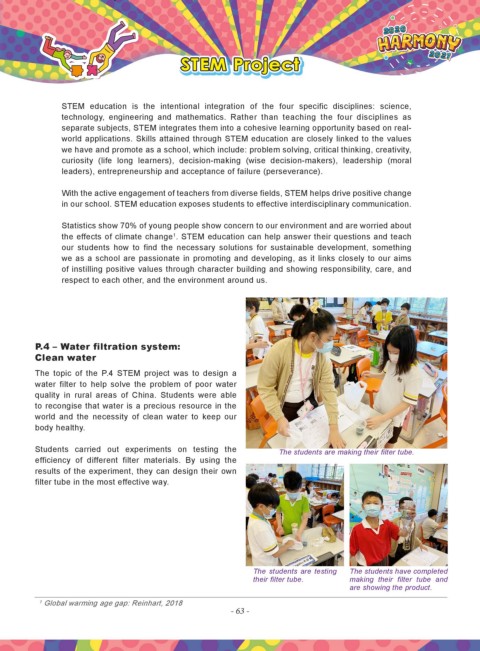
          P.4 – Water filtration system:
          Clean water

          The  topic  of  the  P.4  STEM  project  was  to  design  a
          water filter to help solve the problem of poor water
          quality in rural areas  of China.  Students were able
          to recongise that water is a precious resource in the
          world and the necessity of clean water to keep our
          body healthy.

          Students carried out experiments on testing the             The students are making their filter tube.
          efficiency of different filter materials. By using the
          results of the experiment, they can design their own
          filter tube in the most effective way.


                                                                The students are testing   The students have completed
                                                                their filter tube.      making their filter tube and
                                                                                        are showing the product.

           1  Global warming age gap: Reinhart, 2018
                                                          - 63 -

