


Page 83 - 和富慈善基金李宗德小學 2018-2019校刊
P. 83
The above core values are the combination of key teachings from different religions in Hong Kong, Confucianism, the
               Family Council, and the Education Bureau. The definitions and expected learning outcomes are shown in the following
               table.
                 Core Value                  Definition                        Expected Learning outcomes
                                                                       ► Do your best
                             ● To be responsible in one’s role and try one’s
                Responsibility                                         ► Be responsible for your choices
                               best
                                                                       ► Do what you are supposed to do
                                                                       ► Always tell the truth
                             ● To be and act in a righteous, fair and honest
                  Integrity                                            ► Do the right things
                               manner, and to do what one claims
                                                                       ► Do not cheat or steal
                             ● To take care of themselves              ► Show kindness to others
                             ● To show empathy for the difficult situations of   ► Express gratitude
                               other people and offer timely support to others  ► Help people in need
                    Care
                             ● To care for one’s family, those who need help in   ► Show care to family members, schoolmates
                               the community, the socially vulnerable groups   and friends
                               and the environment                     ► Show empathy to others
                                                                       ► Listen to others
                             ● To know and appreciate the values of oneself   ► Feel deep admiration for someone and
                               and of others, and to accept the uniqueness of   something elicited by their abilities, qualities or
                               and different choices made by other people
                  Respect                                                achievements
                             ● To establish peaceful and friendly relationships   ► Always say “Please”, “Thank you”, “I would like
                               so as to foster harmony in the school and   to ask...” and “May I”, etc.
                               society
                                                                       ►Let people in and make them feel welcome
                             ● To persevere and not give up when faced with
                               difficulties, adversities and failures and to work
                Perseverance   towards finishing one’s goal            ► Dare to try
                                                                       ► Not afraid of failure
                             ● To demonstrate their positive values and
                               attitudes towards life when facing hardship
                                                                       ► Not afraid of difficulties and take on challenges
                             ● To take the initiative to perfect the tasks given   with courage
                 Commitment
                               to them and commit in what they do      ► Show the courage to admit the mistakes made
                                                                         and strive to improve
               We also identify 11 key curriculum components in our school.
               ( I ) Formal Curriculum Components
                  1. Character building in Languages
                  2. Character building in General Studies
                  3. Character building in Physical Education
               (II) Informal Curriculum Components
                  4. Character Building Lessons
                  5. Life Education Period
                  6. Firefly Scheme
                  7. Buddy Scheme
                  8. Morning Assemblies
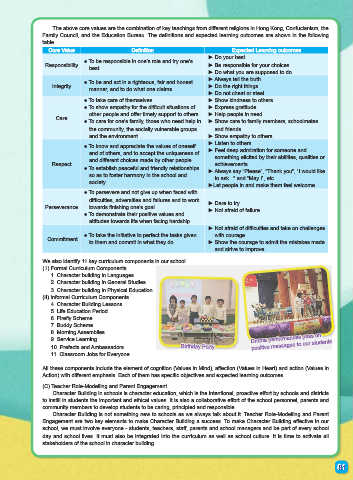
                  9. Service Learning                                                 Drama performances pass on
                  10. Prefects and Ambassadors                Birthday Party          positive messages to our students.
                  11. Classroom Jobs for Everyone

               All these components include the element of cognition (Values in Mind), affection (Values in Heart) and action (Values in
               Action) with different emphasis. Each of them has specific objectives and expected learning outcomes.
               (C) Teacher Role-Modelling and Parent Engagement
                   Character Building in schools is character education, which is the intentional, proactive effort by schools and districts
               to instill in students the important and ethical values. It is also a collaborative effort of the school personnel, parents and
               community members to develop students to be caring, principled and responsible.
                   Character Building is not something new to schools as we always talk about it. Teacher Role-Modelling and Parent
               Engagement are two key elements to make Character Building a success. To make Character Building effective in our
               school, we must involve everyone - students, teachers, staff, parents and school managers and be part of every school
               day and school lives. It must also be integrated into the curriculum as well as school culture. It is time to activate all
               stakeholders of the school in character building.


                                                                                                                   81

