


Page 9 - 伊利沙伯中學舊生會湯國華中學
P. 9
HKCYAA Writing Competition 2025 - Gold


                            A Memorable Journey to Learn
                            A Memorable Journey to Learn

                                          from Ceremonies
                                          from Ceremonies


                                                                                         4C Ng Hei Yeung

             Last summer, I had the unforgettable              to everyone in the tea room, a moment of
         opportunity to visit Kyoto, Japan, a city             peace and respect rarely found in our noisy,
         renowned for its rich history, stunning               KPI-driven world.
         temples, and serene landscapes. Initially, I              Another example was the Misogi, a
         was hesitant about the trip because I only            purification ritual that involved standing
         wished for a holiday doing nothing. However,          under a cold waterfall at a shrine to cleanse
         my Japanese teacher signed me up for the              the body and mind. The coldness was
         exchange program and my parent willingly              shocking,  and  resisting,  and the initial
         endorsed it.                                          urge to retreat was difficult. But hearing

             During my visit to Kyoto with my                  from a temple priest about how this ritual
         classmates, I experienced several traditional         symbolized  washing  away  impurities—
         ceremonies that initially felt unfamiliar and         both physical and spiritual—and reminded
         a bit uncomfortable, but as I learned their           practitioners to live with purity and humility
         stories and cultural significance, I gained a         made me see it as an act of self-healing and
         deep respect for their importance in honoring         respect for the community. The priest asked,
         humanity and spiritual connection.                        “Who has not ever had any regrets?”

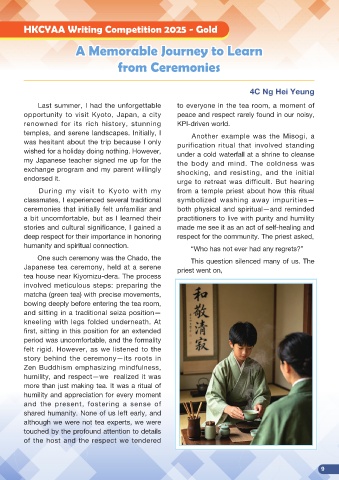
             One such ceremony was the Chado, the                  This question silenced many of us. The
         Japanese tea ceremony, held at a serene               priest went on,
         tea house near Kiyomizu-dera. The process
         involved meticulous steps: preparing the
         matcha (green tea) with precise movements,
         bowing deeply before entering the tea room,
         and sitting in a traditional seiza position—
         kneeling with legs folded underneath. At
         first, sitting in this position for an extended
         period was uncomfortable, and the formality
         felt rigid. However, as we listened to the
         story behind the ceremony—its roots in
         Zen Buddhism emphasizing mindfulness,
         humility, and respect—we  realized it was
         more than just making tea. It was a ritual of
         humility and appreciation for every moment
         and the present, fostering a sense of
         shared humanity. None of us left early, and
         although we were not tea experts, we were
         touched by the profound attention to details
         of the host and the respect we tendered


                                                                                                                  9

